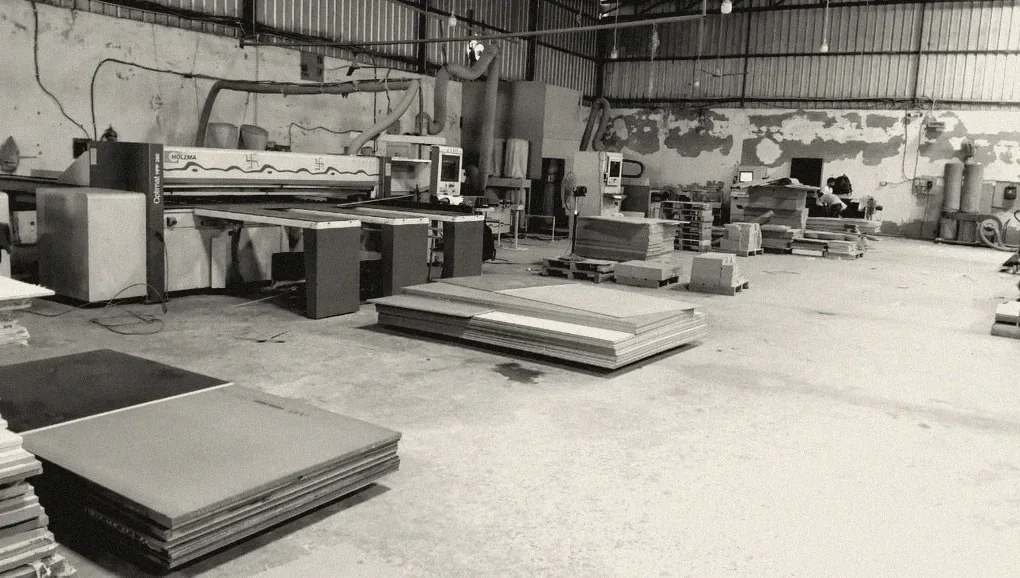
A fit-out contractor with its own workshop makes the joinery, fixtures and metalwork for your project itself, instead of ordering them from separate vendors. That gives the contractor direct control of sampling, quality and the order in which things are made, and it leaves one company answerable when something has to change. It is not the right route for every item, but for retail fixtures, hotel joinery and custom furniture it usually makes a project easier to manage.
What "in-house" should mean
Many contractors describe manufacturing as in-house. Before you rely on it, check three things:
- Ownership. Is the workshop owned and run by the contractor, or is it a partner's facility?
- Processes. Which steps happen there: panel cutting, edge banding, CNC routing, metal fabrication, painting, powder coating, upholstery?
- Supervision. Who checks production against the approved drawings and samples?
What changes when the contractor makes it
- The approved sample is the production standard. Samples and prototypes come from the same workshop, finishes and people as the production run.
- One set of drawings. The team detailing a fixture and the team making it work from the same shop drawings, so fewer details are lost between companies.
- Changes go straight to production. A revised dimension or finish does not wait in another vendor's queue.
- Production follows the site. Fixtures can be made in the order sites become ready, which matters when several stores open in sequence.
- Repeat stores match. The same machines, finishes and checks are used for the first store and the twentieth.
- One party is accountable. If a fixture does not fit on site, there is no back-and-forth between the installer and a supplier.
What is still bought in
Even a contractor with a large workshop buys some items from specialists: glass, natural stone, lighting, catalogue furniture, electrical and HVAC equipment, and appliances. The contractor's job is to coordinate those items with what it makes, so that they arrive and fit together.
Questions to ask before you appoint a contractor
- Can we visit the workshop while our items are in production?
- Which processes are carried out there, and which are subcontracted?
- Which recent projects were produced there?
- How are shop drawings and samples approved before cutting starts?
- What finishing is done in-house: paint, powder coating, upholstery?
- How are fixtures packed and transported to other cities?
- Who installs on site: the contractor's own team or a third party?
Inside the PID Projects workshop
Our workshop at Tikri Kalan, New Delhi, covers 50,000 sq ft. It handles:
- Modular woodwork: a complete HOMAG machinery setup for modular woodwork
- Metal: in-house steel fabrication for frames, fixtures and structure
- Finishing: a full-scale paint booth, powder coating and a dedicated upholstery line
- Handwork: a secondary unit for handwork and detailing
Shop drawings and material samples are approved before anything is cut. Finished fixtures are packed and dispatched to site, where our own teams install them and hand over. You can see the facility on our workshop page, and the fixtures it produces under shopfittings.
Frequently asked questions
Is in-house manufacturing cheaper?
Not automatically. It reduces the cost of rework and coordination between companies, but the price of a fixture still depends on its materials, finish and quantity. Compare like-for-like specifications.
Can one workshop supply a multi-city rollout?
Yes, if production is planned against site dates and packing and transport are organised for distance. PID Projects has delivered 175 outlets for Blackberrys to one brand standard.
Can I approve samples before production?
You should. Ask for physical samples of every finish, veneer, metal and fabric, and approve them in writing before cutting starts.
Related reading: custom retail fixtures and manufacturing approvals and types of retail store fixtures.