Store fixtures do more than hold products. They shape how customers move through a store, what they notice first and how a brand feels in person. This guide covers the main types of retail fixtures, the materials used in Indian shopfitting, and how to specify fixtures that survive daily trading and repeat rollouts.
Main types of retail fixtures
Wall systems and perimeter units
Wall bays carry the bulk of stock in most fashion, beauty and lifestyle stores. They may use slatwall, panel systems with adjustable shelves and hanging rails, or bespoke joinery with integrated lighting. Specify bay widths that match the brand’s visual merchandising grid.
Gondolas and mid-floor units
Freestanding gondolas and mid-floor units hold product in the centre of the store. Keep them low enough to preserve sightlines to the wall displays, and make sure aisles meet the mall’s and fire authority’s width requirements.
Display tables and nesting tables
Tables near the entrance present new arrivals and promotions. Nesting tables create layered displays and can be rearranged for seasonal changes.
Showcases and counters
Glass showcases protect high-value products such as jewellery, watches, cosmetics and electronics. Specify toughened glass, locks, lighting and ventilation together. Cash counters combine point-of-sale equipment, packaging storage and wrapping space, so the electrical and data points must be planned early.
Demonstration and experience fixtures
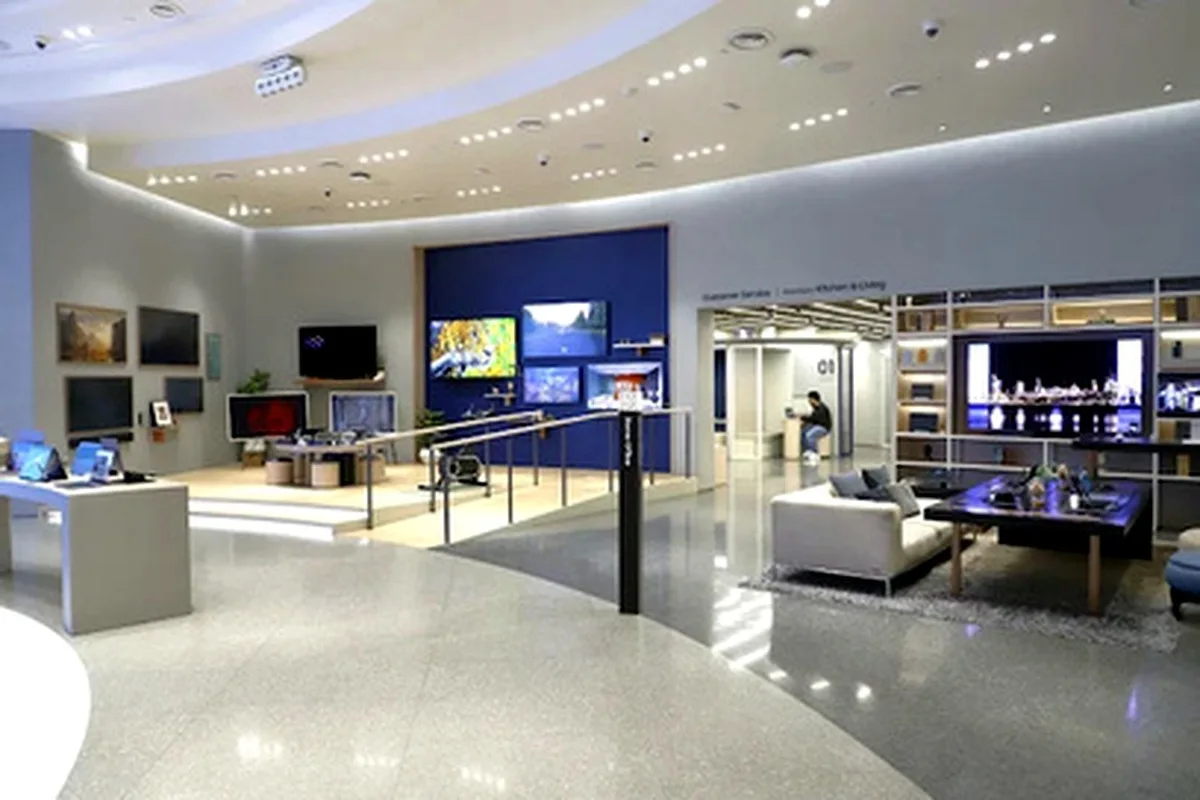
Technology and beauty stores increasingly use demonstration tables with concealed power, security tethers and screens. Our work for the Samsung Experience Centre used circular product displays, open sightlines and dedicated demonstration areas.
Back-of-house storage
Stockroom racking, staff lockers and storage often get overlooked in the budget, but they affect how quickly staff can replenish the floor.
Materials used in shopfitting
- Steel: frames, brackets and structural fixtures, finished by powder coating or plating.
- Engineered boards: MDF, plywood and particle board with laminate, veneer, lacquer or paint finishes.
- Solid wood: for premium joinery and hand-finished details.
- Glass and acrylic: showcases, shelves and signage.
- Stone and solid surfaces: counter tops and feature displays.
- Upholstery: seating and trial-room furniture.
How to specify fixtures that last
- Start from the brand manual and the visual merchandising plan, not from stock catalogues.
- Define loads per shelf and hanging rail, especially for footwear, denim and electronics.
- Choose finishes that resist scuffs and cleaning chemicals.
- Integrate lighting and power at the drawing stage.
- Approve a full-size prototype before batch production.
- Design for flat-pack or modular transport if the fixtures travel to many cities.
Custom vs off-the-shelf fixtures
Off-the-shelf systems are quick and inexpensive for basic formats. Custom shopfittings make sense when the fixture is part of the brand identity, when dimensions must fit a specific store format, or when the same design will be repeated across many stores. Repeat programmes such as our 20 stores for Octave and 18 for Innisfree depend on fixtures being produced to the same standard each time.
Frequently asked questions
What is shopfitting?
Shopfitting is the design detailing, manufacture and installation of the fixtures and joinery that furnish a store, from wall systems and counters to display tables and showcases.
Where are PID Projects fixtures made?
At our 36,000 sq ft workshop in Tikri Kalan, New Delhi, with steel fabrication, modular woodwork, upholstery, painting, powder coating and hand finishing.
Explore our custom shopfittings, see the workshop, or send your fixture drawings.